300,000 broken pages on a PropTech platform. One audit. Organic traffic up 1,379% year over year.
When Valery Real Estate, a property listings platform, rebranded in September 2024, a URL restructure silently broke a third of its website. Croton Content's audit identified the cause. After the fix, organic sessions surged from 974 per week to 12,276.
Croton Content's technical SEO audit of Valery Real Estate identified that approximately 300,000 pages, one-third of the entire website, were returning 404 errors. The root cause: a URL restructure during Valery's September 2024 rebrand had left every old address broken with no redirects in place. After the fix, weekly organic sessions grew from a floor of 974 to a peak of 12,276, and full-year organic sessions increased 1,379% year-over-year.
Pages returning 404 (GSC)
324,580
Crawled, not indexed (GSC)
506,104
2024 organic sessions (launch year)
14,918
2025 organic sessions (post-fix)
220,570
Year-over-year increase
+1,379%
Peak weekly organic sessions
12,276
Organic registrations post-fix (Sep–Dec)
2,985
About Valery Real Estate
Canada's first AI brokerage
Valery Real Estate is Canada's first AI-powered real estate brokerage, based in Vaughan, Ontario. The platform serves both homebuyers and sellers, offering instant property valuations, market trend analysis, MLS listing search across Ontario, and AI-generated action plans, as well as real estate agents who use Valery's tools to handle pricing, timing, and client research.
Like most real estate platforms at Valery's scale, organic traffic depends on programmatic pages: thousands of individual listing and neighbourhood pages generated from a live property database, each targeting long-tail queries (address lookups, city-level searches, property type filters across Ontario). A large programmatic page inventory is a compounding asset when it works. When the URL structure breaks, the damage is measured in hundreds of thousands of lost pages, not dozens.
The challenge
324,580 broken pages and 506,000 that wouldn't index
In early 2025, Valery's organic traffic was in persistent decline. There was no single algorithmic event, no obvious content issue, just slow erosion since launch. A technical SEO audit commissioned through Croton Content identified the cause within the first crawl.
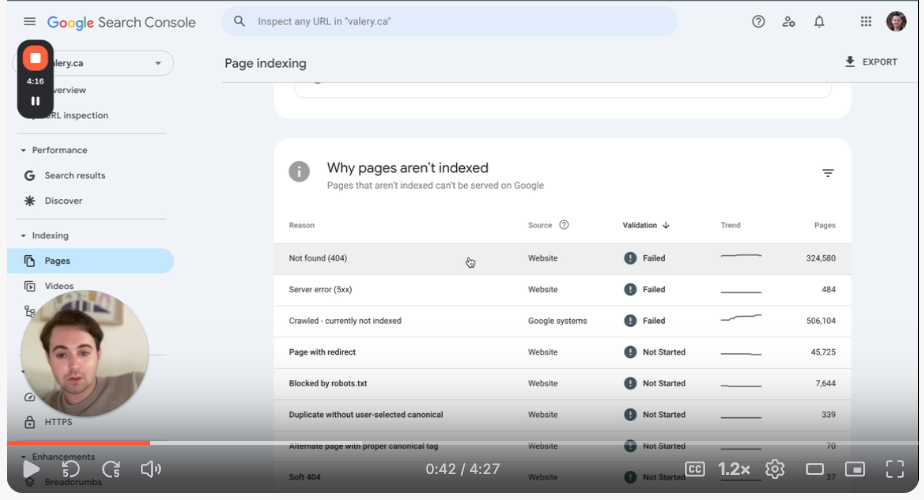
324,580 pages were returning 404 errors. The root cause: Valery's September 2024 rebrand from ChatVal had restructured the site's URL format without implementing redirects from the old addresses. Every old URL remained live in Google's index, in backlinks, and in the XML sitemap. They simply didn't resolve to anything anymore.
A handful of 404 errors is crawl noise. Three hundred thousand is a quality collapse. Google noticed, and it showed in the traffic data.
Google Search Console, Page Indexing report: 324,580 pages returning 404 and 506,104 crawled but not indexed — both marked Failed. This is what Google was seeing while Valery's team was publishing new content.
By May 2025, weekly organic sessions had fallen to 974. That was the floor. The URL problem had been compounding since the day the new site launched.
There was a secondary problem layered beneath the 404s: a cohort of pages Google had crawled but not indexed — 506,104 of them. These were listing pages serving minimal content because full property details were locked behind registration. A page that renders without useful information doesn't meet search intent, and Google won't index what it can't evaluate.
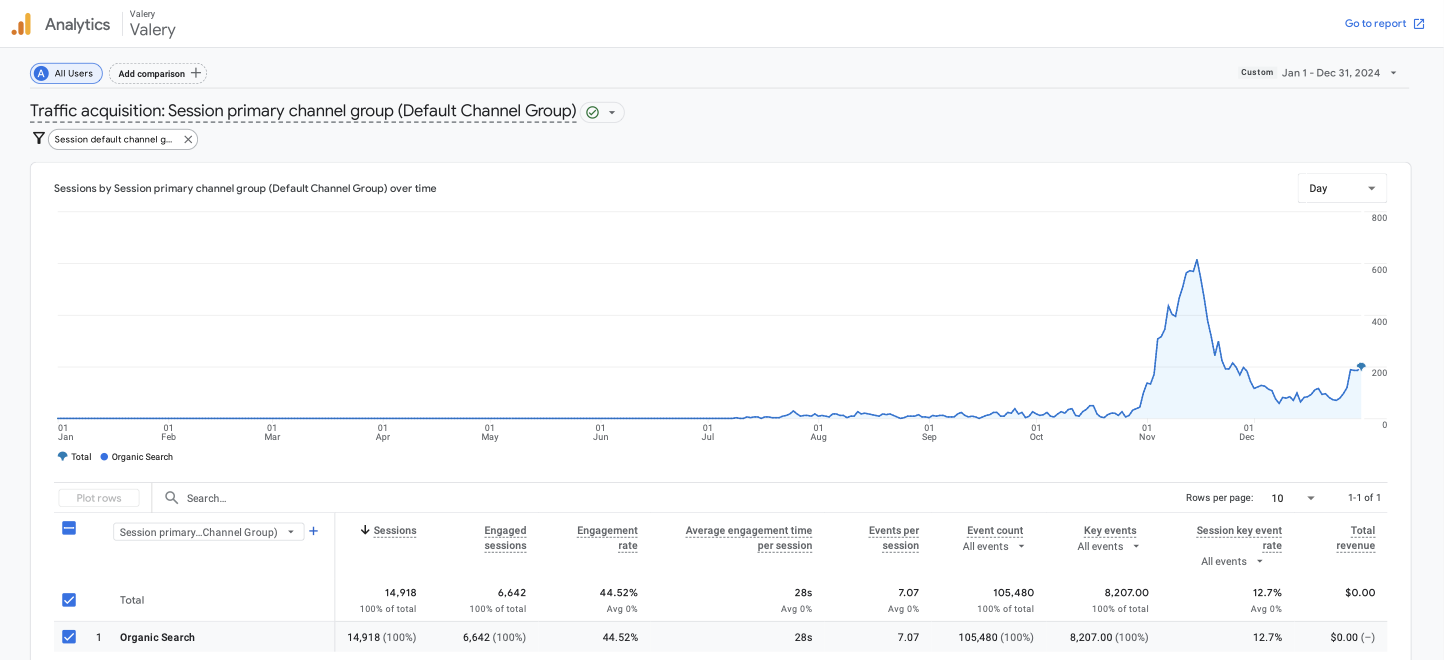
GA4: Valery's full-year 2024 organic sessions. Traffic spiked briefly at launch in September 2024 then declined as the broken URL structure took hold. Total for the year: 14,918 organic sessions.
The strategy
Two prescriptions from one audit
301 redirects at scale
Every broken URL needed a permanent redirect pointing to its working equivalent. A 301 tells Google the resource has permanently moved, transfers link equity from the old address to the new one, and reverses the quality signal that had been accumulating for months. Croton exported the full list of broken URLs and their correct destinations so Valery's development team could implement the redirects in bulk.
Sitemap cleanup
Any broken pages still listed in Valery's XML sitemap needed to be removed. Submitting a sitemap full of 404 errors signals exactly the same thing as the crawl itself: this site is not maintained. Removing them immediately stopped Googlebot from wasting crawl budget on addresses that returned nothing.
Content surface on locked listing pages
For the crawled-but-not-indexed cohort, the recommendation was to expose enough content above the authentication gate for Google to determine the page had value: a headline price, a property summary, a neighbourhood name, a thumbnail. Full listing details could stay locked for registered users. The goal was to give Google something to evaluate.
Result 01
The traffic surge: 974 to 12,276 organic sessions per week
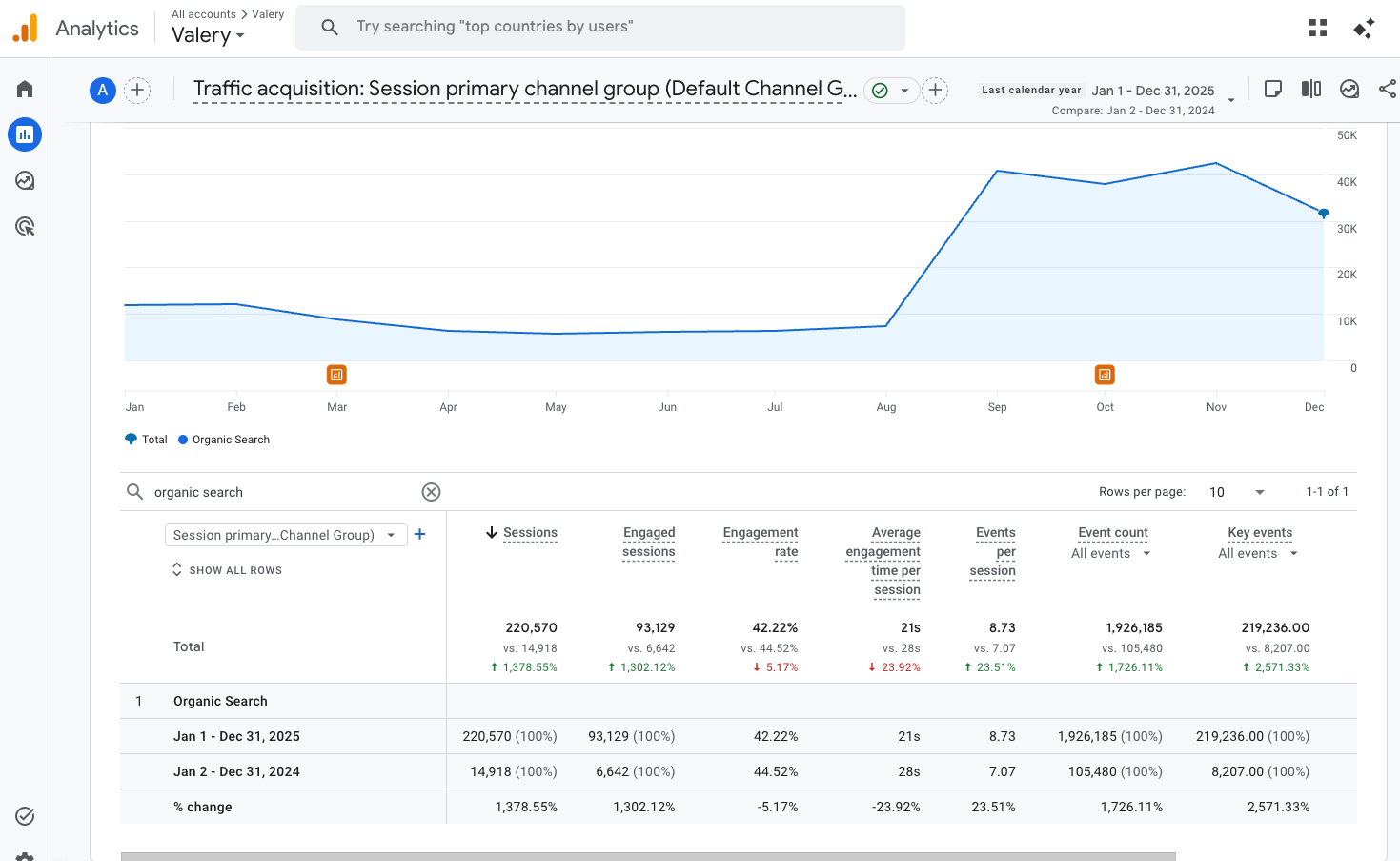
GA4 Traffic Acquisition, Jan–Dec 2025 vs Jan–Dec 2024, Organic Search filter. 220,570 sessions in 2025 versus 14,918 in 2024: +1,378.55%. The monthly chart shows the decline through mid-2025, the September surge, and the sustained Q4 plateau.
Valery launched under its current brand in September 2024. In those first four months, with a broken URL structure from day one, the platform recorded just 14,918 organic sessions across the entire launch year. By May 2025, weekly organic sessions had fallen to a floor of 974.
Valery's development team implemented the 301 redirects in late August 2025, approximately three months after the audit was delivered. The response from Google was rapid. Within days, organic daily sessions began climbing. By the week of September 3–9, weekly sessions had jumped to 5,847. By September 17–23, they peaked at 12,276: a 12.6-times increase from the May floor, in under three weeks.
+1,379%
Organic sessions, year-over-year 14,918 in 2024 → 220,570 in 2025
Note on the 2024 baseline
The 2024 figure (14,918) covers only Q4 2024; Valery launched in September. The GA4 property reports from January 1, with zero sessions prior to launch. The comparison is 14,918 organic sessions in roughly four months at launch versus 220,570 in 2025 after the fix.
Result 02
What actually recovered, and which pages
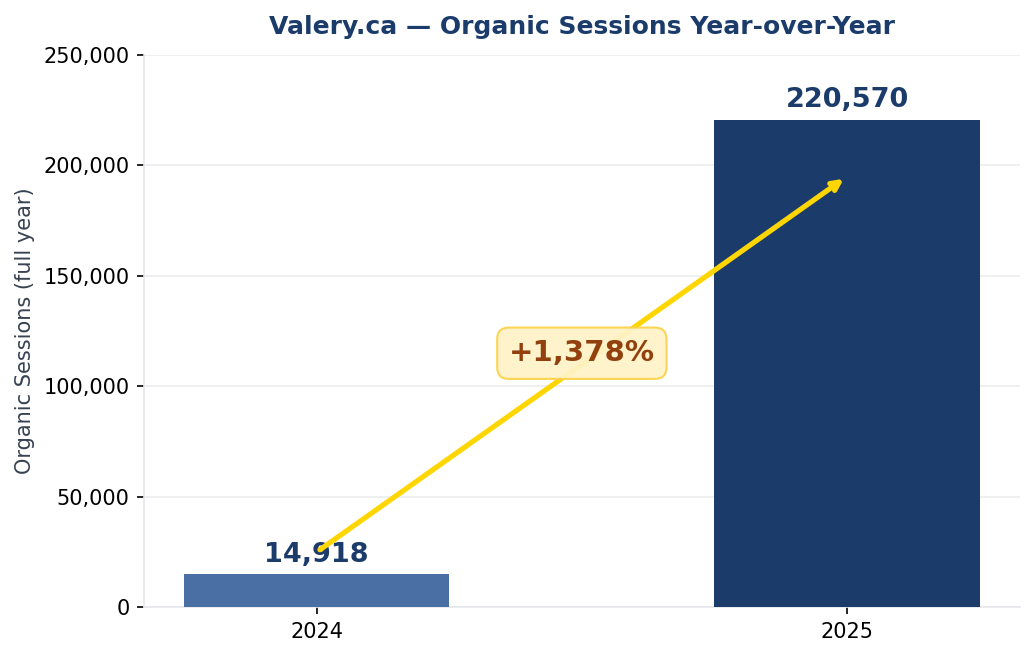
2024 vs 2025 organic sessions. The 1,379% year-over-year increase reflects both the traffic lost to the broken URL structure and the structural recovery after the 301 redirects were implemented.
The traffic recovery was not a transient spike. Organic sessions averaged approximately 8,500 per week across October and November 2025, sustained at roughly 6 times the pre-fix baseline. Organic search was the #1 traffic channel for the year, ahead of direct (163,797 sessions).
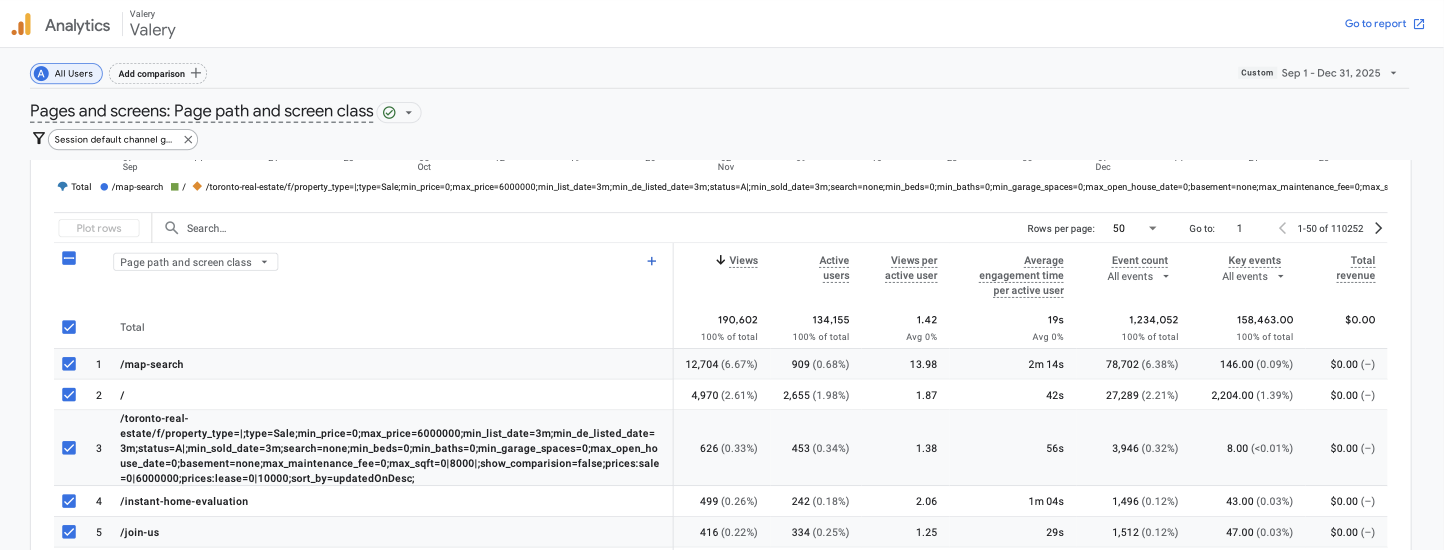
The top-performing page was /map-search: Valery's interactive listing search, with 12,704 views and an average session depth of nearly 14 pages per user. These are not casual visitors: 134 seconds of average engagement time indicates users actively exploring listings.
Below the map search, traffic was distributed across hundreds of individual property listing pages spanning all of Ontario: Toronto, London, Hamilton, Mississauga, Burlington, Ottawa, St. Catharines. These were the programmatic pages the broken URL structure had made invisible to Google for over a year. The 301 redirects did not create new traffic. They unlocked access to authority that had been building while the URLs were broken.
GA4 Pages and Screens, Sep–Dec 2025, organic search filter: 190,602 total views across 110,252 unique pages. /map-search topped the list with 12,704 views and nearly 14 pages per user. The rest of the views are distributed across individual listing pages across Ontario.
Result 03
The traffic converted
Traffic recovery matters more when it converts. In the eight months before the redirect fix (January–August 2025), organic search drove approximately 1,370 user registrations. In the four months after (September–December 2025), organic search drove 2,985: more than double the registrations in half the time.
Honest notes
What this case study does not claim
Croton diagnosed; Valery's team built
The audit identified the problem and exported the redirect list. Valery's developers executed the 301 redirects and sitemap cleanup. The traffic recovery belongs to the team that did the work. Croton's contribution was the diagnosis.
There was a three-month implementation gap
The audit was delivered in May 2025. The redirects went live in late August. Organic traffic sat at the floor for three months between diagnosis and fix. Earlier implementation would have meant earlier recovery.
This was recovery, not growth
The 301 redirect fix solved an acute crisis : a URL structure that had been broken since launch. It recovered ground that the site's programmatic inventory had been building. It did not add new rankings, new content, or new domain authority.
The thin-content problem may persist
Whether the crawled-not-indexed listing pages ultimately get indexed depends on a product decision about content gating. If full listings remain locked, those pages may continue to underperform regardless of the redirect fix.
No revenue model
Real estate leads have highly variable conversion economics by buyer stage, property type, geography, and agent relationship. Unlike the Tiiny.host case study, we have not modelled a revenue figure. Organic traffic recovery and registrations are the metrics we can stand behind cleanly.
What this means for your site
The most expensive SEO problem is often one you cannot see.
Valery's problem was invisible in the normal course of running a website. The pages looked fine to a logged-in user. The content team kept publishing. The problem only became visible when someone looked at what Googlebot was seeing and found that a third of the site had quietly stopped working.
Croton Content is a video-first AEO, SEO, and GEO agency offering technical SEO audits as standalone diagnostic engagements for sites experiencing significant unexplained traffic declines. If your site has a large programmatic inventory (real estate, financial tools, B2B SaaS), a broken URL structure is one of the fastest ways to lose ground that took years to build, and one of the fastest problems to recover from once identified.
Common questions about 404 errors and SEO recovery
What is a 301 redirect and why does it matter for SEO?
A 301 redirect is a permanent server instruction that tells browsers and search engines: this URL has moved to a new address. When Google encounters a 301, it transfers the ranking authority from the old URL to the new destination and updates its index. Without redirects, renamed or restructured URLs disappear from Google's perspective; any authority they accumulated vanishes, and every crawl of the old address returns an error that signals poor site maintenance.
How long does organic traffic take to recover after fixing 404 errors at scale?
It depends on how frequently Google crawls the site and how thoroughly the redirect mapping covers the broken URL inventory. For Valery, organic sessions began climbing within days of the fix, with the majority of the recovery visible within three weeks. Full consolidation of the lifted baseline took through to October. Larger sites with slower crawl frequencies may see a longer lag.
What does "crawled — currently not indexed" mean in Google Search Console?
It means Google visited the page but chose not to include it in search results. The most common reasons: the page content was too thin to satisfy search intent, the page was behind authentication, or the content did not differ enough from other pages. It is different from a 404. A crawled-not-indexed page exists, it just is not useful enough to rank.
What is a technical SEO audit?
A technical SEO audit examines the structural health of a website from Google's perspective: crawlability, indexation, URL structure, redirect chains, site speed, schema markup, internal linking, and mobile usability. The goal is to identify issues that prevent Google from accessing, understanding, or ranking pages, regardless of content quality. For large programmatic sites, technical audits frequently uncover problems that content investment alone cannot fix.
Can a single technical fix really cause a 1,379% traffic increase?
It can, when the underlying problem is structural and at scale. Valery's issue was not thin content or weak backlinks. Valery had 300,000 pages returning errors on every crawl. Once Google could see those pages again and trust that the site was being maintained, the traffic recovery reflected authority that had been accumulating all along, with no way to reach searchers.
Is Croton Content a technical SEO agency?
Croton Content's core service is YouTube SEO and video-first content strategy for financial and B2B brands. Technical SEO audits are available as standalone engagements for sites experiencing significant unexplained traffic declines. The Valery engagement was conducted as part of an ongoing advisory relationship.
Get started
Is your site losing traffic it has already earned?
Book a free Growth Call. If you are experiencing unexplained organic declines, a technical audit is often the first place to look, before investing more in content or links.
We use cookies to enhance your browsing experience, serve personalized ads or content, and analyze our traffic. By clicking "Accept All", you consent to our use of cookies. Privacy Policy
Cookie Preferences
We use cookies to enhance your experience. You can choose which types of cookies to allow:
Necessary Cookies
Always Active
These cookies are essential for the website to function properly.
Analytics Cookies
Help us understand how visitors interact with our website.