YouTube Money Calculator for Finance Channels
Ever wondered how much top finance YouTubers really make? Stop guessing. Our YouTube Money Calculator gives you accurate earnings estimates based on what truly matters: your niche, audience location, and content type. Finance content commands the highest CPMs on YouTube—often earning 3-5x more than gaming or entertainment channels. Use our free calculator to see your channel's true earning potential.
Calculate Your Earnings
Get accurate revenue estimates based on finance-specific CPM data
Your Estimated YouTube Earnings
How We Calculate This
These estimates are based on industry-verified CPM data for finance content. Actual earnings may vary based on content quality, audience engagement, seasonality, and monetized playback rates (typically 60-75% for finance content).
Want to maximize these earnings?
Our YouTube marketing experts help finance creators optimize for higher CPMs and faster growth.
Book a Free Strategy Call →Ready to Dominate YouTube for Your Financial Brand?
Get expert YouTube SEO and video marketing strategies that turn views into revenue. Join dozens of financial brands growing with our proven evergreen content system.
Strategic YouTube SEO
Optimize your videos for search and suggested content algorithms
Evergreen Content Systems
Create content that continues to drive leads and revenue for years
Performance Tracking
Monitor key metrics and optimize your content for maximum ROI
Why Finance YouTube Channels Earn More
Finance content commands premium CPMs because high-value advertisers compete aggressively for this audience. Unlike gaming or vlog content that attracts lower-paying advertisers, finance channels draw investment platforms, banks, fintech companies, and wealth management firms willing to pay $15-$30 per 1,000 ad impressions.
The reason is simple: customer lifetime value. A single customer acquired through a finance YouTube ad can be worth thousands of dollars to advertisers. When someone watches a video about "best investment strategies" or "how to build wealth," they're actively seeking financial solutions—making them highly valuable to advertisers.
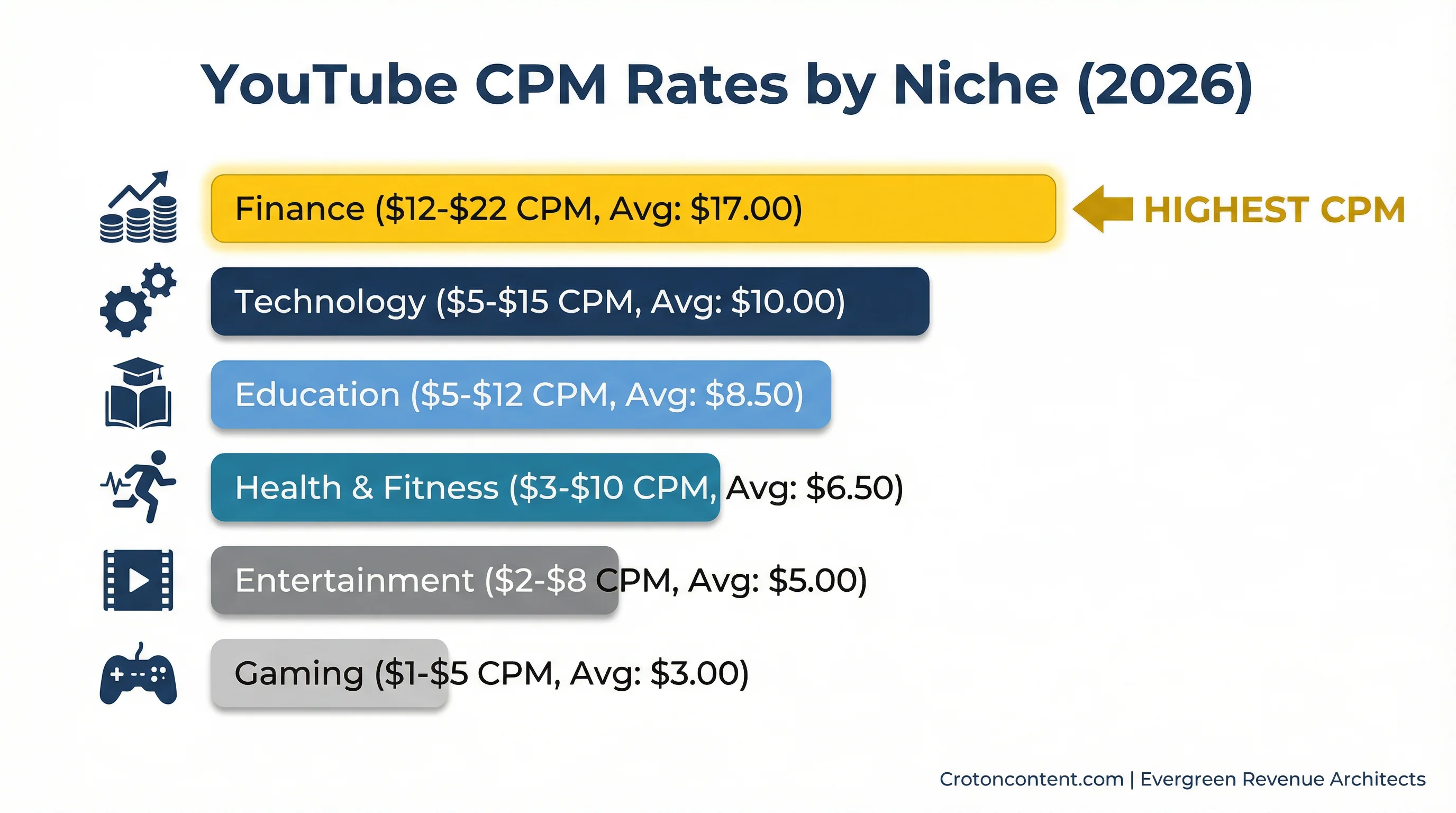
According to industry research on YouTube CPM rates, personal finance content earns $12-$22 CPM, while making money online content reaches $15-$20 CPM. Compare this to gaming ($1-$5 CPM) or entertainment ($2-$8 CPM), and the difference is staggering.
This is why our calculator focuses specifically on finance niches. Generic YouTube money calculators use average CPM rates ($3-$5) that drastically underestimate what finance creators actually earn. If you're creating content about investing, cryptocurrency, real estate, or personal finance, you deserve accurate projections based on your niche's true earning potential.
How Much Do Finance YouTubers Make Per 1,000 Views?
Finance YouTubers typically earn $6-$15 per 1,000 views (RPM), depending on their specific sub-niche and audience demographics. This is the actual money in your pocket after YouTube takes its 45% cut. To put this in perspective, a finance channel with 100,000 monthly views can earn between $600 and $1,500 per month—significantly more than the $300-$500 a gaming channel would earn with the same views.
The earnings breakdown by finance sub-niche looks like this:
- Investment & Stock Market Analysis: $8-$14 RPM (highest earning)
- Financial Planning & Wealth Management: $10-$15 RPM
- Real Estate Investing: $7-$12 RPM
- Personal Finance Education: $6-$11 RPM
- Cryptocurrency & Blockchain: $5-$10 RPM (volatile, depends on market conditions)
- Banking & Fintech: $8-$14 RPM
Why such variation? Advertisers pay more for audiences with higher purchasing power and immediate buying intent. Someone watching "wealth management strategies" is likely a high-net-worth individual, while someone watching "budgeting tips for students" has less immediate value to advertisers—though still far more than non-finance content.
For comparison, here's what other popular niches earn per 1,000 views:
- Gaming: $1-$3 RPM
- Vlogs/Lifestyle: $2-$4 RPM
- Entertainment: $2-$5 RPM
- Technology: $3-$8 RPM
- Education: $3-$7 RPM
The finance advantage is clear. If you're creating financial content, you're in one of the most lucrative niches on YouTube. Our YouTube marketing services help finance creators optimize their channels to capture these premium CPM rates.
YouTube CPM vs RPM: What Finance Creators Need to Know
CPM (Cost Per Mille) is what advertisers pay YouTube for 1,000 ad impressions, while RPM (Revenue Per Mille) is what you, the creator, actually earn per 1,000 video views. Understanding this distinction is crucial for setting realistic earnings expectations.
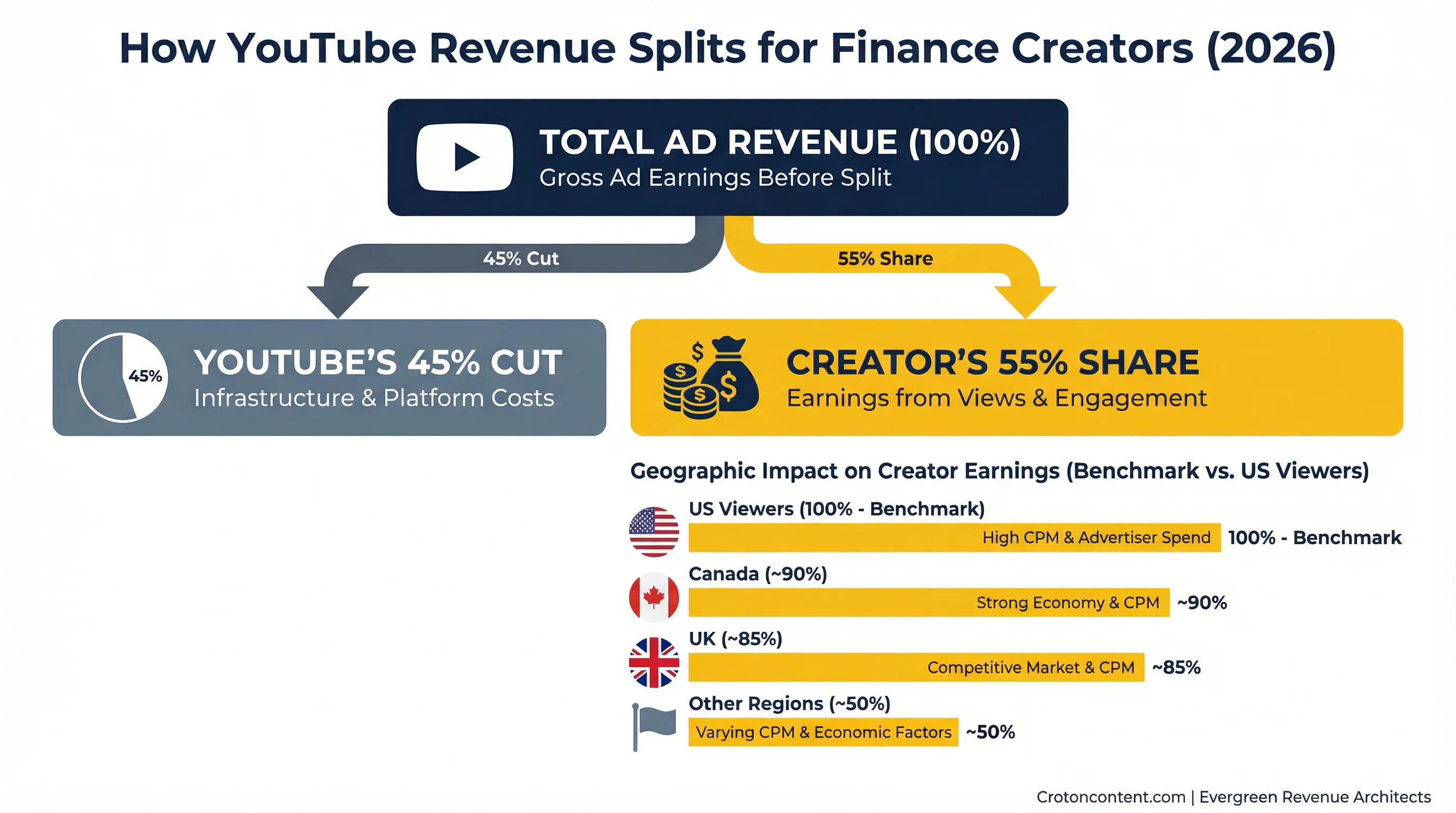
Here's how the math works: If your finance niche has a $15 CPM, you don't earn $15 per 1,000 views. YouTube takes a 45% cut of all ad revenue through the YouTube Partner Program, leaving you with 55%. Additionally, not all viewers see ads—some use ad blockers, and some videos aren't fully monetized.
The Formula:
RPM = (CPM × 0.55) × Monetized Playback Percentage
For example:
- CPM: $15 (what advertisers pay)
- YouTube's cut: 45% ($6.75)
- Your share: 55% ($8.25)
- Monetized playback: 70% (typical for finance content)
- Your actual RPM: $8.25 × 0.70 = $5.78 per 1,000 views
Finance content typically has higher monetized playback percentages (60-75%) compared to entertainment (40-60%) because finance audiences tend to be older, use fewer ad blockers, and watch on devices where ads are harder to skip.
This is why our calculator shows earnings as ranges rather than single numbers. Your actual RPM depends on dozens of factors: viewer geography, device type, time of year, video length, and audience engagement. The calculator accounts for the most important variables—niche and geography—to give you realistic estimates.
How to Maximize Your Financial YouTube Earnings
Creating finance content puts you in a high-CPM niche, but there are specific strategies to maximize your earnings even further. Here's what top-earning finance creators do differently:
1. Optimize Video Length for Mid-Roll Ads
Videos over 8 minutes are eligible for mid-roll ads, which can double your ad revenue. Finance content naturally fits longer formats—a comprehensive tutorial on "How to Build a Stock Portfolio" or "Real Estate Investment Analysis" can easily run 10-20 minutes while providing genuine value.
The earnings difference is substantial. A 5-minute video might show 1-2 ads, earning $3-$6 per 1,000 views. A 15-minute video can show 4-6 ads, earning $8-$15 per 1,000 views—more than double the revenue for the same viewership. Our YouTube tag generator can help optimize longer videos for better discoverability, and our YouTube channel name generator can help you create a memorable brand.
2. Target High-CPM Geographies
An 80% US audience versus a 50% US audience can mean a 40% difference in revenue. While you shouldn't compromise content quality to chase geography, you can optimize upload times, use region-specific examples, and promote content in high-CPM markets.
For finance creators, the CPM hierarchy looks like this:
- United States: Baseline (highest)
- Australia: 95% of US rates
- Canada: 90% of US rates
- United Kingdom: 85% of US rates
- Western Europe: 70% of US rates
- Other regions: 50% of US rates
3. Create Advertiser-Friendly Finance Content
Finance content walks a fine line. Advertisers love financial education but avoid "get rich quick" schemes or unverified investment advice. To maintain premium CPMs:
- Include proper financial disclaimers
- Avoid sensational claims ("Turn $100 into $10,000!")
- Focus on education over promotion
- Comply with FTC guidelines for sponsored content
- Avoid controversial financial topics that may limit ad inventory
Channels that maintain advertiser-friendly content see 20-40% higher CPMs than those flagged for limited ads.
4. Leverage Seasonal CPM Spikes
Finance content experiences predictable CPM fluctuations:
- Q4 (October-December): CPMs increase 30-50% as advertisers spend year-end budgets
- Tax Season (January-April): Personal finance content sees 20-30% CPM increases
- Earnings Season (Quarterly): Investment content peaks during corporate earnings reports
- Summer (June-August): CPMs typically drop 10-20%
Plan your content calendar around these trends. Publish your best, longest content during high-CPM periods to maximize revenue. Our YouTube SEO services help finance creators optimize publishing schedules for maximum earnings.
5. Improve Audience Retention
Higher retention rates signal quality to YouTube's algorithm, leading to better ad placement and higher CPMs. Finance viewers typically have 50-70% average retention (versus 30-40% for entertainment), but you can push this higher with:
- Strong hooks in the first 30 seconds
- Visual aids (charts, graphs, screen recordings)
- Chapter markers for easy navigation
- Practical, actionable advice
- Clear structure and pacing
A video with 70% retention will earn significantly more than one with 40% retention, even with identical view counts.
Common YouTube Earnings Mistakes Finance Creators Make
Even experienced finance creators make mistakes that cost them thousands in potential revenue. Here are the most common pitfalls and how to avoid them:
1. Targeting Low-CPM Keywords
Not all finance keywords are created equal. "Budget finance tips" might attract a broad audience but commands only $8-$10 CPM. "Wealth management strategies" or "tax-advantaged investment accounts" attract smaller, higher-value audiences with $20-$28 CPMs.
Review your video titles and descriptions. Are you targeting beginner-level, low-value keywords, or advanced, high-value topics? A strategic shift toward premium keywords can increase earnings by 50-100% without changing your view count.
2. Ignoring Geography Optimization
Many creators don't realize that 80% of their revenue might come from 40% of their views. If you're getting significant traffic from low-CPM regions, consider:
- Creating region-specific content for high-CPM markets
- Optimizing upload times for US/UK/Canada time zones
- Using English-language content (highest CPMs globally)
- Promoting videos in high-value markets through community posts
3. Making Videos Too Short
The difference between a 6-minute video and a 12-minute video isn't just double the content—it's often triple the revenue. Short videos miss mid-roll ad opportunities and signal lower value to YouTube's algorithm.
Finance content should naturally be comprehensive. If your videos are under 8 minutes, you're likely leaving money on the table. Expand with examples, case studies, deeper analysis, or step-by-step walkthroughs.
4. Poor Thumbnail and Title CTR
Low click-through rates don't just mean fewer views—they also mean YouTube shows fewer ads on your content. The algorithm assumes low-CTR content is less engaging and reduces ad load accordingly.
Finance thumbnails that work:
- Clear, readable text (even on mobile)
- Professional design (not clickbait)
- Numbers and data points
- Contrasting colors
- Faces showing authority/trust
Use our YouTube hashtag generator to improve discoverability and CTR through strategic hashtag use.
YouTube Shorts vs Long-Form: Earnings Comparison for Finance Content
YouTube Shorts have exploded in popularity, but their monetization model is fundamentally different from long-form content—and far less lucrative for finance creators.
Shorts RPM
$0.05-$0.10
per 1,000 views
Long-Form RPM
$6-$15
per 1,000 views
That's a 60-150x difference in earnings. A Short with 1 million views might earn $50-$100, while a long-form video with 1 million views could earn $6,000-$15,000.
Why such a massive gap? Shorts monetization comes from a shared ad revenue pool, not direct ads on your content. YouTube pools all Shorts ad revenue and distributes it based on view share. Long-form videos, by contrast, show direct ads with premium CPMs.
When to Use Shorts (Despite Lower Earnings):
Shorts aren't worthless—they're excellent for top-of-funnel audience growth. Use Shorts to:
- Attract new subscribers (who'll watch long-form content)
- Test content ideas quickly
- Repurpose long-form content into bite-sized clips
- Build authority and brand recognition
- Drive traffic to high-earning long-form videos
The Finance Creator Strategy:
Top finance creators use a hybrid approach:
- Shorts for growth: 2-3 Shorts per week to attract new viewers
- Long-form for revenue: 1-2 comprehensive videos per week (10-20 minutes)
- Cross-promotion: End Shorts with CTAs to long-form content
- Funnel optimization: Shorts → Subscribers → Long-form views → Revenue
Think of Shorts as marketing and long-form as your product. A million Short views might earn $100, but if those views convert to 10,000 long-form views, you've earned $60-$150 from the long-form content—plus built a sustainable audience.
Frequently Asked Questions
Where does this CPM data come from?
How accurate is this calculator?
What are the YouTube Partner Program requirements?
How can I increase my channel's CPM?
How much do finance YouTubers make per 1,000 views?
Does video length affect YouTube earnings?
Why does my YouTube CPM fluctuate so much?
How long does it take to start earning on YouTube?
Are YouTube Shorts worth it for finance creators?
Ready to Grow Your Finance Channel?
Now that you know your earning potential, it's time to maximize it. Our YouTube marketing experts specialize in helping finance creators optimize for higher CPMs, faster growth, and sustainable revenue.